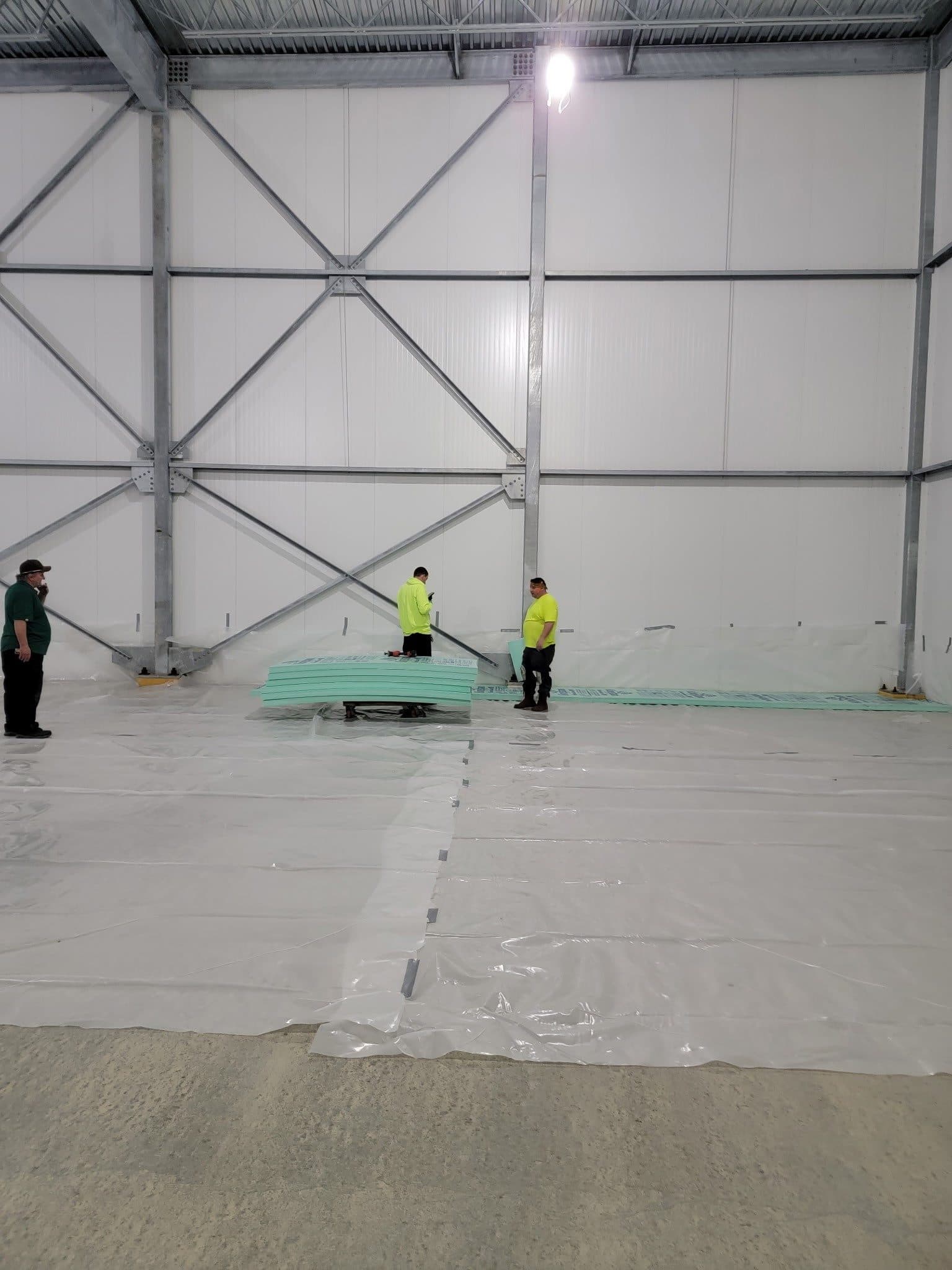
Freezer floor heave: what causes it and how to prevent it.
Freezer floor heave: the ground under the slab freezes, expands and lifts the floor. What it looks like, how far it spreads, and how to catch it or prevent it.
Freezer and blast-freezer floor insulation, designed before the pour. Installed by our crews, or supplied material-only to the contractor on the job.
Keep pulling heat out of a room and you pull it out of the ground under it.
A freezer without a properly designed floor assembly does not fail politely. Ground below the slab freezes and expands, and the floor lifts with it. It does not settle back.
Cracking is usually the first thing anyone sees. By then the heave has started, and once it starts it speeds up: ice builds under the slab in a cone and spreads outward.
The time to deal with it is before the slab is poured. Board type, density, layers and subfloor heat are specified per project against the slab, the load, the racking and the operating temperature.
What heave does to a building.
Doors and seals stop working
Once the floor moves, openings move with it. Doors bind, seals stop meeting, and the room starts losing what it is supposed to hold.
It leaves the freezer
Heave can travel out past the freezer walls through unheated door approaches. It lifts steel columns and cracks masonry. Don Ross has seen floors come up three to four feet in a school-district commissary freezer.
Lost usable space
A heaved area stops being storage. In the worst cases the room stops being usable at all.
Watch the subsoil, not the floor.
Temperature sensors under the slab, in conduit so they can be pulled and replaced, tell you what the ground is doing before the floor does. Act when the subsoil reaches 45°F. By 40°F it is too late to respond. Once a floor has heaved, the fixes are limited and expensive: directional boring under the slab, glycol heat. Often a new freezer, or turning the room into a cooler, is the more practical answer.
Questions buyers ask
What causes freezer floor heave?
Cold from the freezer reaches the ground under the slab. The ground freezes, the water in it expands, and the slab lifts. A floor assembly with the right insulation, and heat under it where needed, keeps the ground from freezing.
What are the first signs of freezer floor heave?
Cracking in the slab, usually. Subsoil temperature tells you sooner: sensors in retrievable conduit under the floor, and action when the subsoil reaches 45°F. By 40°F it is too late to respond.
Can freezer floor heave be fixed?
The options are limited and expensive: directional boring under the slab and glycol heat. Often it is more practical to build a new freezer, or to turn the room into a cooler. Call with photographs and we will tell you what we see.
Can heave spread beyond the freezer?
Yes. It can move out through unheated door approaches, lift steel columns and crack masonry outside the freezer walls.
What insulation goes under a freezer floor?
Rigid board selected for the slab, the load and the racking, in a deliberate non-scored grade. Scored backfill and foundation board is a different product for a different job, and substituting it is where floor assemblies quietly go wrong.
Does a blast freezer floor need something different?
Yes. The temperature is more severe and the assembly under a blast freezer is specified accordingly.
Related: freezer floor insulation, why the board is extruded polystyrene and failed freezer consulting.
Planning a freezer, or watching a floor move?
Drawings if you are planning. Photographs of cracks, thresholds and doors if the floor is already moving.
(216) 631-8080Monday – Friday, 8:00 AM – 4:00 PM. 3195 West 63rd Street, Cleveland, OH 44102.
Related figures, projects and articles from D.W. Ross.